Thimi Low Table
-
Design
-
Furniture
The Thimi Low Table takes its name from the town east of Kathmandu where its timber is sourced — a community of woodworkers who have been processing sal and teak for Kathmandu Valley's building and furniture trades for generations. The table began as a response to a simple observation: that most Nepali households conduct their most important daily rituals — meals, tea, conversation, children's homework — at floor level, yet the furniture available to support this life is either imported and ill-proportioned or locally made with little attention to surface quality or material honesty.
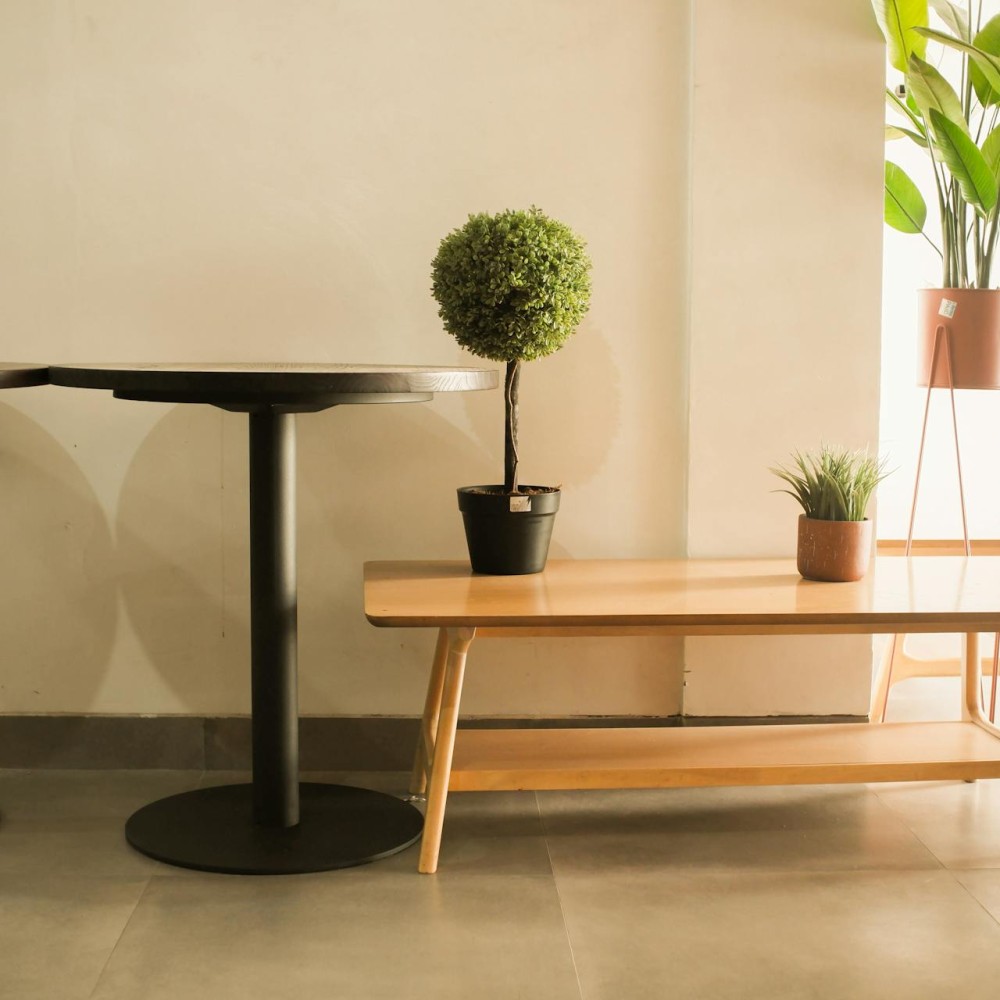
The form is deliberately reduced: four slightly tapered legs, hand-turned on a traditional lathe, join a single thick-slab top whose natural edge is retained on two sides and hand-planed flat on the other two. The join between leg and top uses a draw-bore mortise-and-tenon, a technique that tightens with use rather than loosening over time. The surface is finished with three successive coats of raw linseed oil, rubbed in by hand and buffed between coats — a finish that feeds the wood, darkens it slightly, and leaves a surface that improves with age and handling rather than requiring periodic refinishing.
Each table is made individually to order from a single slab, meaning no two are identical in grain character or natural edge profile. Dimensions are fixed — 900mm long, 500mm wide, 280mm high — but the client may specify additional lower shelf, which is suspended between the legs on two thin sal dowels and provides storage for books, fruit, or a tea set. The table is made entirely at the Nirman Objects workshop in Bhaktapur by a team of four craftspeople, with a production time of approximately three weeks per piece.
-
Study Chair
- Next